Sliding Doors vs Casement Doors for Indian Living Rooms: Which Is Better?
July 23, 2026
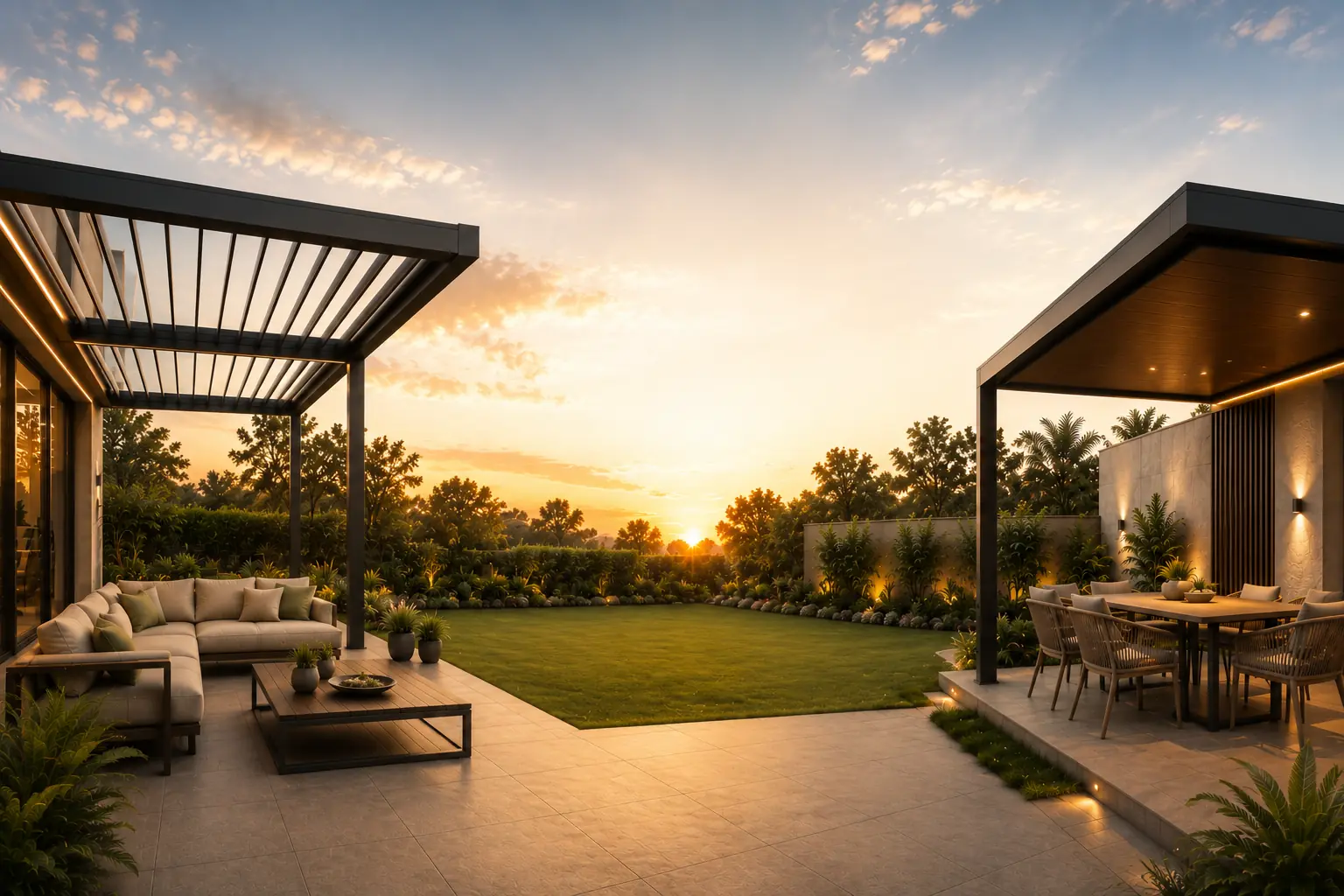
A pergola can change the way an outdoor space is used, but only when it is planned as part of the house and not treated like a decorative structure added later. That is why pergola design for homes has become a much more serious planning question than it used to be.
If you are considering a pergola for a lawn edge, courtyard, deck, or terrace, the main decision usually comes down to roof type. Do you choose a fixed roof system that gives predictable cover and a cleaner sense of permanence? Or do you choose a louvered roof system that offers more control through the day and across seasons?
We, at Fabricasto, look at pergolas in exactly that larger way. A pergola should bring comfort, shade, and architectural value together. It should help the outdoor area feel more usable without making it feel heavy or improvised. That is what makes this comparison worth doing carefully.
Outdoor living in India has changed. Terraces are no longer treated as leftover roof area in many homes. Courtyards are being designed more deliberately. Garden edges are expected to become actual sitting zones rather than visual extras. And in premium homes, outdoor spaces are increasingly expected to feel as considered as the interiors.
That is one reason pergola design for homes has become such a strong category. The pergola is no longer only about shade. It is about extending the house outward in a way that feels useful and visually controlled. A well-designed pergola can turn a terrace into an evening seating space, make a side lawn more usable, or help a courtyard become a daily part of the home rather than a transitional zone.
At a basic level, the difference is simple. A fixed roof pergola gives you a permanent cover condition. A louvered pergola gives you an adjustable roof, usually through rotating blades or slats that can open and close to control light, air, and protection.
But in practice, the difference is much wider than that.
A fixed roof system is about consistency. The spatial experience stays more stable. The covered zone behaves more like an outdoor room. A louvered system is about flexibility. It lets the space respond to weather and time of day more actively. That makes it especially relevant in climates where outdoor conditions shift sharply between morning, afternoon, evening, summer, and monsoon.
| Parameter | Louvered Roof Pergola | Fixed Roof Pergola |
|---|---|---|
| Primary strength | Adjustable light, shade, and ventilation | Stable, constant cover |
| Best for | Homes that want more control across seasons and times of day | Homes that want a more defined covered outdoor room |
| Visual character | Slightly more technical, more dynamic | Calmer, more architectural, more settled |
| Rain response | Good when closed, depending on system design and drainage | Reliable if the roof and drainage are well detailed |
| Heat management | Better day-to-day flexibility in changing sun conditions | Depends more on roof build-up and ventilation around the structure |
| Maintenance pattern | More moving parts, so more system care | Simpler system logic, usually steadier upkeep |
| Design fit | Strong for premium, feature-led outdoor spaces | Strong for integrated, quieter residential architecture |
A fixed roof pergola is often the stronger choice when you want the outdoor area to behave like a room with dependable shelter. It gives a steadier spatial result. Once it is built well, the experience below it remains clear and predictable. That makes it useful in settings where the pergola is expected to support dining, lounging, or regular sitting without too much adjustment.
This is why a fixed roof often works well in bespoke terrace pergola designs where the terrace is meant to feel more like an outdoor extension of the house than a weather-responsive feature space. If the family wants a more settled outdoor dining area, a fixed roof may make more sense than a louvered one.
A fixed roof can also suit homes where the architecture already has a quiet, integrated language. In these cases, the pergola should not call too much attention to its mechanism. It should simply belong to the structure and help the outdoor zone feel complete.
The strength of a fixed roof can also become its limit. Because the cover is constant, the space has less flexibility. If the terrace receives pleasant winter sun but harsh summer glare, a fixed system cannot adapt the way a louvered one can. If you want more sky visibility on some days and deeper cover on others, the fixed roof will always feel like one decision made once.
That does not make it a weaker option. It simply means it is best where the desired use pattern is already clear. A fixed roof works best when you want a stable condition, not an adjustable one.
Louvered pergola roof designs are often the better answer when the outdoor zone needs to work across changing conditions. They are particularly useful in Indian homes because outdoor comfort changes so sharply through the day and across the year. Morning and evening can be pleasant. Midday can be harsh. Monsoon periods can ask for quick shelter. That is exactly where adjustability starts becoming more than a premium feature.
A louvered roof can let you open the structure for air movement and partial sky when conditions are comfortable, then close it down when stronger shade or rain protection is needed. That makes the pergola feel more responsive. In some homes, this is the difference between a terrace that is used occasionally and one that becomes part of daily living.
This is also why louvered systems often suit more feature-led outdoor spaces. If the pergola sits in a highly used terrace, a central entertainment zone, or a visible poolside edge, the ability to tune the environment adds real value.
This is where many buying decisions improve. Homeowners often begin with the image they like more. That is natural. But in India, the climate should usually get more say than aesthetics.
A west-facing terrace in Delhi or Gurgaon behaves very differently from a garden corner in Bangalore or a courtyard in Chandigarh. A metal pergola for a terrace garden in NCR conditions may need stronger control over glare and afternoon heat than one in a milder setting. In such situations, a louvered roof may become the smarter answer because it gives you more day-to-day adjustment.
On the other hand, if the pergola sits in a more protected zone or if the primary need is steady all-weather cover rather than variable comfort, a fixed roof may still be better. So the right roof is often the one that solves the climate problem most honestly, not the one that looks more advanced on paper.
Any roof-like structure in India has to answer one unavoidable question: where does the water go?
This matters for both pergola types, but especially on terraces. Indian waterproofing guidance makes the broader point clearly: roof surfaces need proper drainage and should be sloped enough to avoid standing water. Even though a pergola is not the same as a full slab roof, the same logic still matters. Water must move away cleanly. It should not collect on the system, back up into junctions, or create trouble at the connection between the pergola and the building.
A fixed roof asks for good drainage design because the roof condition is always closed. A louvered system asks for good drainage design because the water path must still work when the louvers are closed. In other words, neither system can rely on appearance alone. The drainage logic has to be built into the system from the start.
Neither system is maintenance-free. Their needs are simply different. A fixed roof pergola has fewer moving parts. Routine work usually involves cleaning the frame, clearing gutters, checking sealant lines, and inspecting roof junctions. If the system has solid panels or glass, those surfaces also need periodic cleaning.
A louvered pergola needs the same basic care, with added attention to pivots, motors, wiring, and blade movement. Dust can collect around the louvres, especially in Delhi NCR, and drainage channels must remain clear before the monsoon. Motorised systems also benefit from planned servicing rather than waiting for movement to become uneven.
Aluminium itself is well suited to exterior use because architectural alloys resist weathering, corrosion, and UV exposure. But the finish, fasteners, drainage, and moving components still decide how steadily the complete structure ages. Good maintenance protects the system around the material, not only the aluminium.
The best pergola design for homes is the one that makes the outdoor area easier to use without working against the architecture or climate.
A fixed roof pergola gives you steady shelter, a calmer visual form, and simpler maintenance. A louvered system gives you greater control over sunlight, airflow, and changing weather. Neither option is automatically more premium. The quality comes from choosing the right system and resolving its structure, drainage, services, and finishes properly.
We, at Fabricasto, see pergolas as part of the home rather than attachments to it. When the roof type follows the site and the detailing follows the intended use, a terrace or garden stops feeling like leftover outdoor space. It becomes a part of the home that people actually return to.
Mon - Sat 9.00 to 17.00
+91-9818630247
Mon - Sat 9.00 to 17.00
+91-9818630247

Fabricasto is a trusted provider of premium doors, windows, skylights, retractable roofs, and internal partition systems. We deliver innovative architectural solutions designed to enhance aesthetics, functionality, comfort, and long-term value for residential and commercial spaces.
341, CRC Estate, MG Road, Sultanpur, New Delhi 110030
SCO-7, Block-E, Mohali Citi Centre Avenue, Punjab
Faridabad, Pali Village, Haryana 121004