AI-Powered Windows: How Artificial Intelligence Is Transforming Modern Homes
September 04, 2026
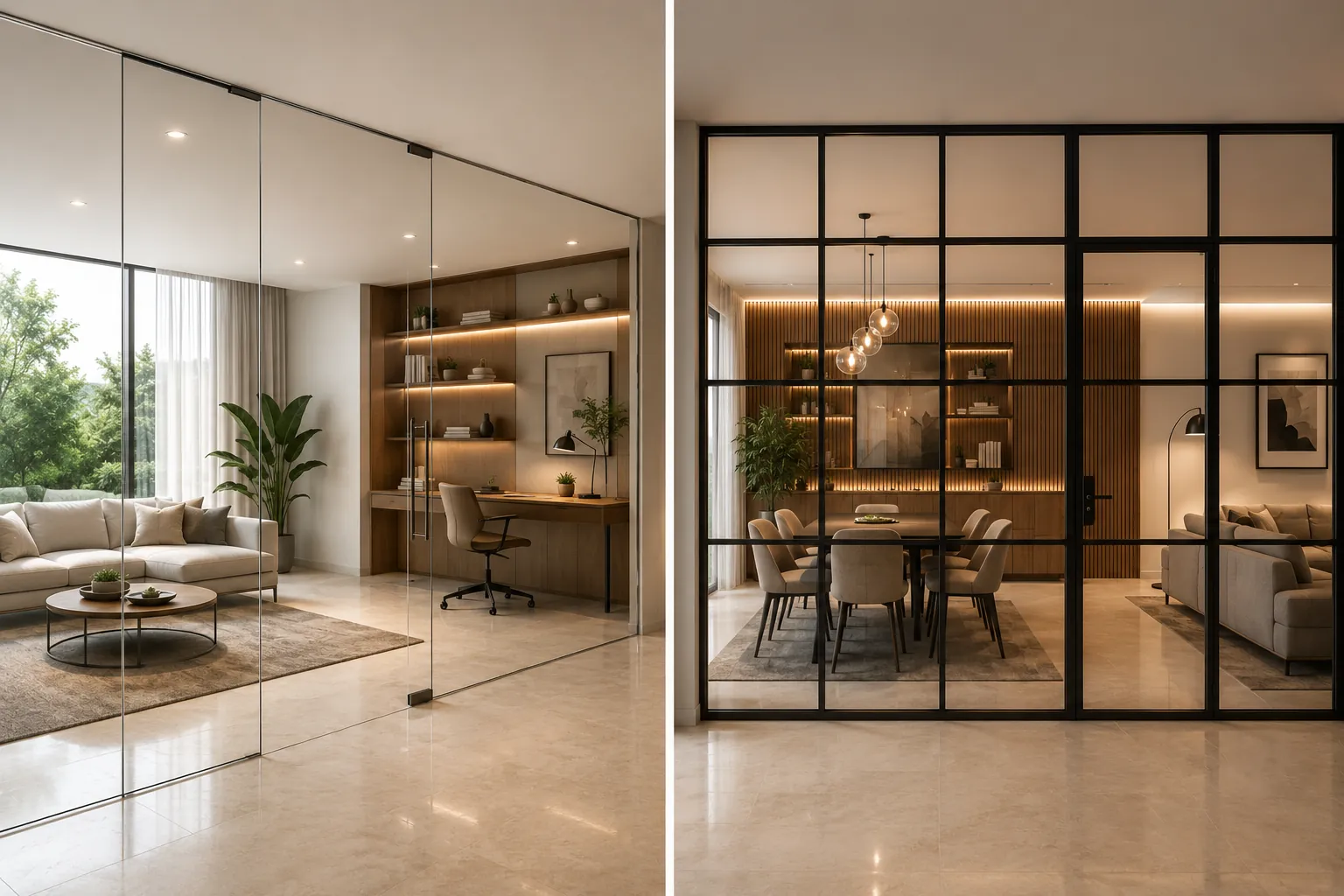
Glass partitions have changed the way premium homes are planned. They are no longer used only to divide space. They now shape how light travels, how rooms stay connected, and how open a home can feel without giving up structure and control. That is why the question is no longer whether you should use glass at all. In many luxury homes, the real question is what kind of glass partition gives the right result.
That is where frameless glass partition design and slim-profile aluminium systems begin to part ways. Both can look premium. Both can feel contemporary. But they do not create the same kind of space.
We, at Fabricasto, see this choice as part of a larger interior decision. A partition should not only divide. It should support the home’s design language, the room’s behaviour, and how the space will actually be used every day. Fabricasto’s own interior positioning already points in that direction, with partitions and internal doors treated as part of a more tailored, design-led interior system rather than separate utility products.
In an ordinary fit-out, a partition is often treated like a neutral divider. In a premium home, it is not neutral at all. It affects how the room reads from the very first glance. It changes how natural light reaches the interior. It controls how much visual calm or articulation the house carries.
This is why glass partitions for homes have become such a strong category in luxury residential design. A good partition can make the plan feel layered without feeling cut up. It can separate a study from a lounge, a dining zone from a family room, or a dressing space from a bedroom without resorting to heavy walls or clumsy timber screens.
Once you decide to use glass, the next step becomes more refined. Do you want the partition to feel almost invisible, or do you want it to bring a stronger line and rhythm into the room? That is the real choice between frameless and slim-profile aluminium.
These two terms are often used casually, but they describe two quite different design intentions.
A frameless partition usually relies on large glass panels with minimal visible perimeter framing. The visual goal is openness and continuity. You notice the space more than the system. This is why frameless solutions are often chosen when the owner wants the room to feel lighter, more open, and less interrupted.
A slim-profile aluminium glass partition design works differently. The glass is still central, but the aluminium members remain visible as part of the aesthetic. The frame is not bulky, but it is present. It introduces line, structure, and a little more definition to the space. In the best versions, this does not feel heavy. It feels precise.
| Parameter | Frameless Glass Partition | Slim-Profile Aluminium Glass Partition |
|---|---|---|
| Visual effect | Cleaner, quieter, more transparent | More defined, more architectural, slightly more graphic |
| Sense of enclosure | Lighter and more open | More controlled and better articulated |
| Best fit for | Minimal interiors, open visual flow, spaces that need to feel larger | Homes that want structure, rhythm, and stronger detail language |
| Privacy control | More dependent on glass choice alone | Can combine frame and glass to create more nuanced privacy |
| Tolerance for site errors | Lower; mistakes show more quickly | Slightly more forgiving because the frame helps absorb and organise the detail |
| Design continuity | Best where the room should feel almost uninterrupted | Best where the partition should feel like part of the architecture |
A frameless glass partition design works best when the interior is trying to stay visually quiet. It suits homes where the emphasis is on openness, soft daylight movement, and reduced visual interruption. If the surrounding design language is minimal and the idea is to keep the partition almost invisible, frameless usually has the advantage.
This can work especially well between living and dining areas, between a study and a lounge, or around a courtyard edge where the home is trying to keep a strong visual connection from one zone to another. In these spaces, a visible frame may feel unnecessary if the room already has enough architectural structure elsewhere.
Frameless designs also tend to suit homes where the material palette is already calm and restrained. Stone, plaster, timber, soft metal accents, and clean ceiling lines often pair well with frameless glass because the partition does not compete with them. It lets the volume of the room stay more dominant than the system itself.
This is the part many people skip. Frameless is not always the more sophisticated choice simply because it looks more minimal in reference images. In some homes, it can begin to feel too invisible, too generic, or too dependent on hardware details that were never meant to carry the whole visual burden.
A frameless partition also asks more of installation accuracy. If the lines are not clean, the floor and ceiling conditions are slightly off, or the glass junctions are not handled properly, the minimalism starts working against the design. There is less to hide behind. Every slight inconsistency stays visible.
This is also where use matters. If the space needs more acoustic control, stronger edge definition, or a clearer sense of room separation, a frameless partition may not always feel enough. It may divide visually, but not convincingly enough in the way the room behaves.
A slim-profile aluminium glass partition does not try to vanish completely. It accepts that the partition is part of the room and uses that presence well. The best versions feel deliberate, not intrusive. They create a finer edge around the glass and make the divider feel more integrated with the architecture.
This is why aluminium glass partition design has become such a strong option in luxury homes that want a more structured modern language. The slim frame can bring clarity without bulk. It can align with shadow lines, internal doors, skirting logic, and even other aluminium elements in the project.
This is also where the connection to slim-profile aluminium windows becomes relevant. In many premium homes, the interior and exterior are no longer designed as separate worlds. If the house already uses slim-profile aluminium windows or exterior glazing systems, a slim-profile internal partition often feels more coherent than a fully frameless divider. The language carries through the home more naturally.
Luxury interiors often rely on detail hierarchy. Not every element should disappear. Some should quietly organise the room. A slimline glass partition for homes can do that well. It introduces proportion, rhythm, and a stronger design edge while still preserving lightness.
This is one reason slimline glass partitions have become more desirable in residences that want a little more definition than frameless systems offer. It works especially well in homes where black, bronze, champagne, or darker aluminium finishes already appear elsewhere in the interior. In that setting, the partition begins to feel like part of the interior architecture rather than a neutral divider placed after the fact.
The frame also helps the partition sit more confidently in larger homes where the scale is bigger, and the rooms need more visual structure. In a very large room, a fully frameless partition can sometimes feel visually too slight. A slim-profile system often handles that scale better.
Living and dining zones: If the aim is broad openness and a softer division, frameless often works well. If the house already has a more graphic or architectural interior language, slim-profile aluminium may feel stronger.
Home offices and study areas: Slim-profile systems often have an advantage here because they create a more defined room edge. That can make the workspace feel more intentional, especially when some privacy and enclosure matter.
Bedroom and dressing transitions: This depends on the mood of the room. Frameless can feel lighter and calmer. Slim-profile systems can add more structure and detail, especially in larger master suites.
Luxury bathrooms and spa-like zones: Frameless often feels more relaxed in wet-area-adjacent interiors, but only when the detailing is excellent. Slim-profile aluminium can work beautifully too, especially if the wider home already uses strong metal lines.
This is where the conversation has to become more practical. A partition inside a home may feel visually light, but it is still a large glass element in a lived-in space. People pass by it, brush against it, open and close adjacent doors near it, and in some cases children or guests may not immediately register a clear panel as a physical boundary.
That is why glass used in interior partitions should not be treated casually. The relevant safety question is not only whether the glass is thick. It is whether the glass type, height, support condition, and likely human contact have all been considered properly. In good luxury projects, these decisions are built into the partition from the start rather than treated as technical corrections after the design has already been approved.
This is one reason frameless systems ask for more discipline. When the frame almost disappears, the glass itself carries more of the visual and physical responsibility. In slim-profile aluminium systems, the frame helps organise the edge and gives the partition a clearer physical presence, which can be useful in busy family homes.
The best partition for a luxury home is not the one that disappears most completely or the one with the thinnest visible frame. It is the one that makes the room feel more finished, more intentional, and easier to live with over time.
If your home needs a calm visual flow, a frameless glass partition design may be the better choice. If it needs more structure, rhythm, and architectural control, a slim-profile aluminium system may do the job better. Both can be beautiful. Both can be premium. The right choice depends on what the room needs, what the house already says, and how you want the space to behave every day.
We, at Fabricasto, see that as the real mark of a good interior decision. Not whether it follows a trend, but whether it belongs fully to the home.
Both can look premium, but they create different kinds of luxury. Frameless suits quieter, more minimal interiors where visual interruption should stay low. Slim-profile aluminium suits homes that want more architectural definition and sharper lines. The better choice is the one that makes the room feel more resolved, not simply the more expensive one.
No. A frameless glass partition design works beautifully in some modern interiors, especially where openness and visual continuity matter most. But in homes that need stronger detail language or more room definition, slim-profile aluminium may actually feel more complete and better integrated with the rest of the architecture.
Not at all. A good aluminium glass partition design can feel extremely refined. The frame does not automatically make the partition heavier or less sophisticated. In many luxury homes, the slim line of aluminium adds control, rhythm, and proportion, making the whole room feel more carefully designed.

Mon - Sat 9.00 to 17.00
+91-9818630247
Mon - Sat 9.00 to 17.00
+91-9818630247

Fabricasto is a trusted provider of premium doors, windows, skylights, retractable roofs, and internal partition systems. We deliver innovative architectural solutions designed to enhance aesthetics, functionality, comfort, and long-term value for residential and commercial spaces.
341, CRC Estate, MG Road, Sultanpur, New Delhi 110030
SCO-7, Block-E, Mohali Citi Centre Avenue, Punjab
Faridabad, Pali Village, Haryana 121004