Aluminium Doors and Windows: The Complete Guide for Modern Homes
September 16, 2026
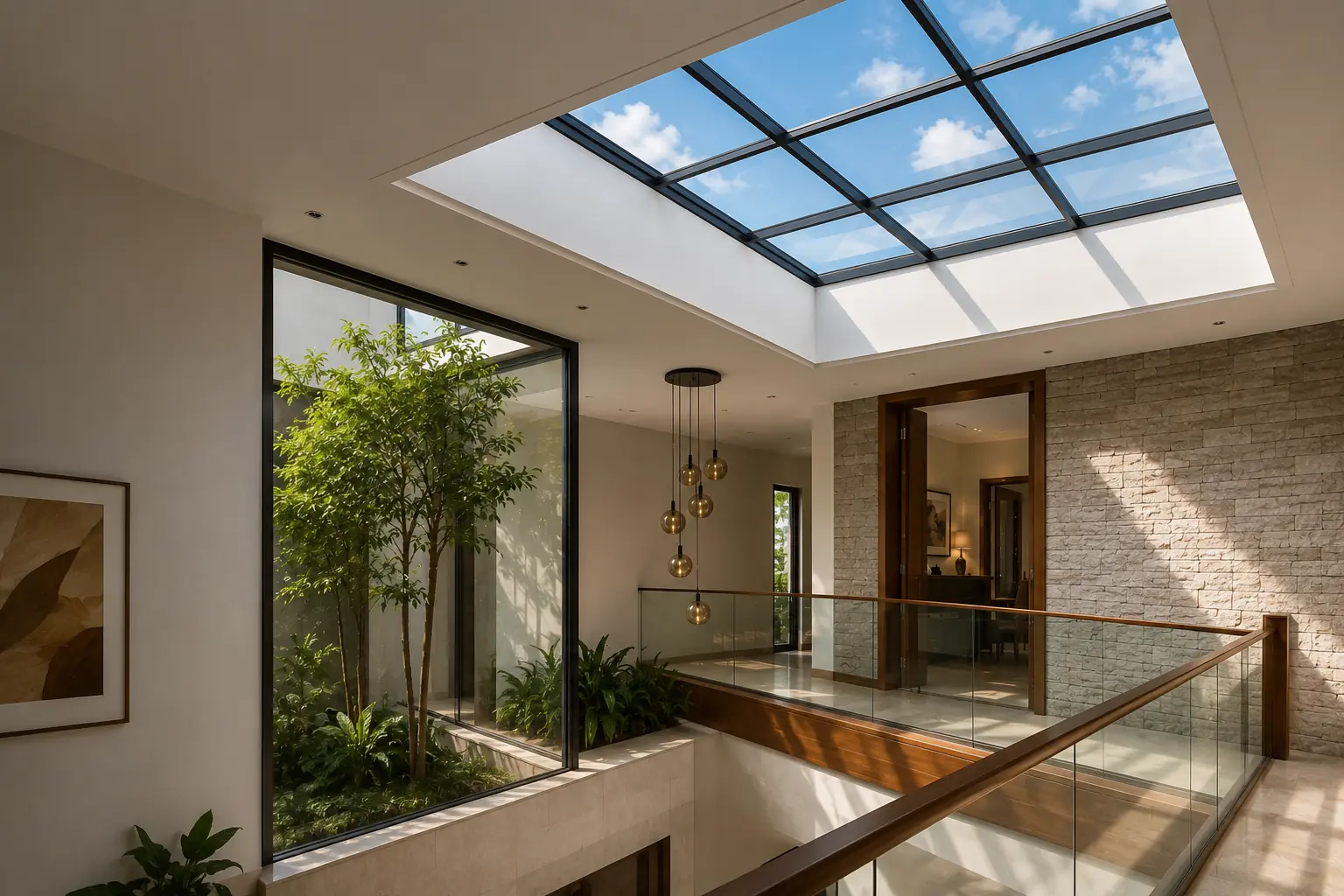
A skylight can change a home more than most people expect. It adds light, changes how a room feels through the day, how the ceiling is experienced, how deep daylight travels into the plan, and how the house connects with the sky. That is why skylight design for homes in India cannot be treated as a decorative glass insert cut into the roof after everything else is done.
In Indian homes, skylights need much more discipline than inspiration images suggest. They deal with sharp sun, monsoon rain, roof waterproofing, glare control, dust, cleaning access, and, in many homes, the need to bring light into courtyards, stairwells, lounges, and upper-floor passages without overheating them. A good skylight solves those things together. A bad one becomes a leak, a heat trap, or a cleaning problem disguised as a design feature.
We, at Fabricasto, look at skylights from that broader architectural point of view. A skylight should not only look premium from below. It should belong to the house structurally, visually, and practically. That is also where premium system thinking matters. In homes that lean towards a more European, refined design language, this is the kind of conversation where brands like Soranzo enter softly as part of a more disciplined approach to aluminium and glass design.
In colder or milder climates, skylights are often discussed mainly as daylight devices. In India, that conversation is wider. You still want daylight, of course, but you also need to ask what kind of light comes in, at what time, on what roof, and with what effect on heat and maintenance.
A skylight over a double-height stair in Delhi will behave differently from one over a courtyard in Bangalore. A glass roof over a passage in Gurgaon will not age the same way as a smaller opening over a dressing space in Pune. That is why the “best skylight” is never a universal answer. The design has to respond to location, roof condition, opening size, and daily use.
This is also why Indian glass guidance treats skylights and overhead glazing more seriously than many homeowners expect. Overhead glazing is not ordinary vertical glass. It is safety-critical and load-sensitive. That changes the way the system should be specified from the start.
The comparison sounds visual at first, but the differences are much more practical. You are choosing how the skylight will collect light, shed water, sit on the roof, respond to heat, and relate to the architecture below.
| Type | Main Visual Quality | Where it Works Well | Main Thing to Watch |
|---|---|---|---|
| Flat skylight | Clean, minimal, contemporary | Modern homes, courtyards, terraces, circulation zones | Heat gain, waterproofing, glass specification, drainage |
| Pyramid skylight | More sculptural, more dimensional from outside | Feature zones, entrance foyers, double heights | Structural detailing, slope control, cost, visual fit |
| Dome skylight roof | Softer, more expressive, often iconic | Traditional-modern homes, special feature spaces, some terrace conditions | Cleaning, optical clarity, visual compatibility, detailing quality |
Flat skylights are usually the first choice in contemporary homes because they look quiet and architectural. They sit well with clean roof lines, minimalist interiors, and restrained detailing. If your house already has a strong modern language, a flat skylight often feels like the most natural extension of that.
This is one reason glass skylight design in premium Indian homes often begins with flat forms. A flat skylight can work especially well over courtyards, internal lounges, stair cores, or circulation zones where the aim is controlled daylight and a cleaner ceiling expression. It also works well when the skylight is meant to read less like an object and more like part of the architecture.
But flat skylights are also where people go wrong fastest. Because they look simple, they get treated as simple. They are not. A flat skylight needs correct glass build-up, proper support, disciplined edge detailing, and absolutely clear drainage logic. Indian safety guidance for overhead glazing is already clear that skylights belong to a more sensitive category of glazing, and sloped or overhead glazing used in skylight roofs is generally expected to use tempered or laminated safety glass and be designed for the relevant loads.
That is why flat skylights are often the best-looking option in theory and the highest-risk option in careless execution.
Fixed glass roof for courtyards: A fixed glass roof for courtyards is one of the strongest use cases for a flat skylight. It allows you to keep the courtyard visually open while protecting the space below from direct rain. In many urban homes, this can make the house’s core more usable without sacrificing the quality of top light.
The design challenge here is balance. If the glass is too exposed and unshaded, the courtyard may become too harsh through parts of the day. If the opening is too timid, the whole point of the skylight is lost. This is where section design, glass selection, and placement matter much more than the overall idea alone.
Open terrace glass design: A flat skylight can also work as part of an open terrace glass design, especially when you want to bring daylight to a level below without making the terrace feel visually crowded. In such cases, the skylight should not behave like an obstruction. It should sit low, clean, and properly integrated with roof levels and walking paths.
This is also the condition where load, drainage, and waterproofing become even more important. A terrace is not only a roof. It is often a usable surface. So the skylight has to be resolved as part of roof behaviour, not only as a light source.
A pyramid skylight design does something flat skylights usually do not. It announces itself. It creates a roof form, not only a roof opening. That can be a strength when the space below is meant to feel ceremonial, dramatic, or clearly defined by top light.
Pyramid skylights often work well over entry foyers, prayer rooms, stairheads, or double-height central spaces where the skylight is meant to become part of the room’s identity. From the exterior too, they add more volume and articulation than a flat rooflight. In homes where the architecture can handle that expression, they can be extremely effective.
They also have practical advantages. Because the surfaces are sloped, water shedding is generally more naturally resolved than in poorly detailed flat skylights. That does not remove the need for proper drainage and flashing, but it changes the risk profile somewhat. A pyramid rooflight often gives you a little more forgiveness in how the top surface handles rain, though the base detailing still has to be exact.
The biggest challenge with pyramid skylights is proportion. A poorly proportioned pyramid can look too commercial, too bulky, or too ornamental for a residence. This is where many homeowners fall into the trap of liking the idea but not checking whether the house can actually carry that form.
The second challenge is structural clarity. A pyramid skylight has more geometry, more joints, and more visible framing logic than a flat skylight. That means fabrication quality shows very quickly. If the members are clumsy, the angles are awkward, or the glass sizes are not well resolved, the whole system feels heavier than it should.
So a pyramid skylight is rarely the “safe default”. It is usually the right choice when you want the skylight to have presence, and you are prepared to detail it properly.
A dome skylight roof sits differently from both flat and pyramid forms. It tends to feel softer, more continuous, and more sculptural. In some homes, it can introduce a more classical or feature-led quality. In others, especially where the dome is handled in a modern way, it can feel unexpectedly clean and elegant.
Domes are often chosen when the skylight is meant to feel like a central object rather than a hidden source of light. They can work over stair cores, atrium-like spaces, and dramatic interior centres where the roof light is meant to become a visual anchor.
The challenge, again, is compatibility. A dome skylight in the wrong house can look disconnected from the rest of the architecture. This is why dome forms usually work best when the design language already allows a little more expression or softness.
The best skylight is not the one that photographs best from below. It is the one that gives the right kind of daylight, sits properly on the roof, handles rain well, and still feels right after years of use. That is why the choice between flat, pyramid, and dome is not only a visual one. It is a planning decision.
If you are exploring skylight design for homes in India, start with the room, the climate, and the roof condition. Then choose the form that fits those realities. We, at Fabricasto, see that as the difference between a skylight that looks impressive on day one and one that remains a good architectural decision for the life of the home.
There is no single best shape for every home. Flat skylights usually suit modern houses and cleaner roof lines. Pyramid skylights work well for feature spaces such as foyers and double-height rooms. Dome skylights suit more expressive or softer architectural styles. The right answer depends on the room, roof, climate exposure, and daylight needs.
They are not risky by default, but they demand more careful detailing than many people expect. A flat skylight needs proper support, a reliable upstand, good waterproofing, and clear drainage planning. In Indian conditions, poor execution shows up quickly through heat build-up, water ingress, or staining around the edges.
Not always. A pyramid skylight design often handles rain runoff more naturally and gives stronger visual presence, but it is not automatically better. It costs more to fabricate well and can feel too bulky if the house or room cannot support that expression. The choice should follow the space, not fashion.


Mon - Sat 9.00 to 17.00
+91-9818630247
Mon - Sat 9.00 to 17.00
+91-9818630247

Fabricasto is a trusted provider of premium doors, windows, skylights, retractable roofs, and internal partition systems. We deliver innovative architectural solutions designed to enhance aesthetics, functionality, comfort, and long-term value for residential and commercial spaces.
341, CRC Estate, MG Road, Sultanpur, New Delhi 110030
SCO-7, Block-E, Mohali Citi Centre Avenue, Punjab
Faridabad, Pali Village, Haryana 121004